
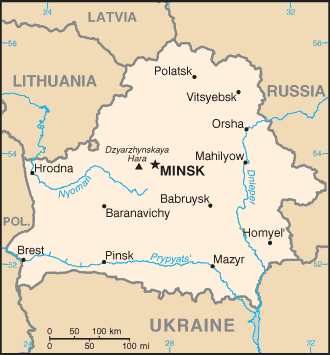
Europe’s last “outpost of tyranny” may be trying to soften its surface image abroad. Belarusian President Aleksandr Lukashenko has reportedly hired the services of PR expert Lord Tim Bell to help abate mounting Western criticism. Lukashenko, president of Belarus since 20 July 1994, has endured caustic condemnation by Western leaders for his country’s setbacks to democratic reform. Criticism of the leader hit an all-time high in October 2004, when a referendum, scrapping the two-term presidential limit, was enforced. This subsequently allowed the current president to run for a successful consecutive third term; an election turnout that prompted virulence from the West, but congratulatory accolades from former President Putin.
Lukashenko, himself, and several of his ministers, have been banned from traveling to E.U. countries and the United States. While Belarus’ GDP has seen significant growth (nearly 7% in 2007), many foreign investors are skeptical and wary of investing in a country marked by authoritarianism and renationalization. A PR campaign should come as no surprise as an obligatory step needed to improve the political and economic image of Lukashenko and Belarus.
Lord Bell is a distinguished British advertising and public relations executive, who has played a critical role in improving public perceptions of notable figures such as former Prime Minister Margaret Thatcher and Russian oligarch Boris Berezovsky. However, Lord Bell’s reported engagement of services with Lukashenko raises a number of questions, notably his ties to current clients.
Representing Berezovsky for six years, Lord Bell has been instrumental in countering (mostly Russian) aspersion of the oligarch. The PR expert even helped Berezovsky with raising the public’s awareness of his acquaintance, former state security officer Aleksandr Litvinenko. In 2006, Lord Bell began to offer advice to Litvinenko’s relatives and Alex Goldfarb, the former Russian officer’s spokesman during his dying days in a London hospital. It was Lord Bell who helped to propagate the prominent and provocative photograph of a bald Litvinenko sitting in a hospital bed, afflicted by the poisoning of the radioactive element, polonium-210.
Tensions between Russia and Great Britain over the Litvinenko affair continue to this day. For Lord Bell to encroach upon this sensitive subject, given his current British clients, might well prove to be damaging to his career. More so, to enlist in the services of a pro-Kremlin presidential actor would either compliment his extensive international clientele or hinder his image at home. Whatever the case, what is important to watch is how Lukashenko is presented in the next year; how the Western media presents him to the general public and how he will be perceived. Undoubtedly, Lord Bell will have his work cut out for him to improve the image of what many Western analysts brand the last dictator in Europe.









 Posts
Posts

