Wednesday, December 17, 2008

Russian Activists Assail Government Treason Bill


Just in from the AP, this report is threateningly corrosive to what little democracy Russia has left under its current prime minister. Here's to you, Time Magazine, on your excellent choice for Person of the Year.

MOSCOW – Russian rights activists say that a new law drafted by Prime Minister Vladimir Putin's Cabinet would allow authorities to label any government critic a traitor.

The draft extends the definition of treason from breaching Russia's external security to damage to the nation's constitutional order, sovereignty or territorial integrity.

A group of prominent rights activists, including head of the Moscow Helsinki Group Lyudmila Alexeyeva and head of Civic Assistance Svetlana Gannushkina, said in a statement Wednesday that passage of the bill would return the nation's justice system to the times of Soviet dictator Josef Stalin's purges.

The government systematically rolled back Russia's post-Soviet political freedoms during Putin's eight-year presidential tenure.

Tuesday, December 16, 2008

Central Asia: Russian General Claims US Wants to Build Two Military Bases in Region


I noticed that General Makarov had been making the news a lot lately, so here is an additional article from EurasiaNet about his thoughts on US involvement in Central Asia (naturally, Russia's sphere of influence).

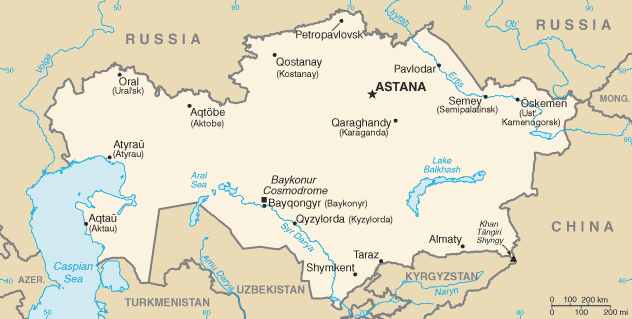
The United States is planning to set up military bases in Uzbekistan and Kazakhstan, Russia’s top general is claiming.

Russia’s armed forces chief of staff, Gen. Nikolai Makarov, revealed the news during an event at the Academy of Military Science in Moscow on December 16, saying that he had information that Washington was actively pursuing new facilities in Central Asia. "American military bases are dotted throughout the world. The US has opened bases in Romania and Bulgaria, and according to our information, [it] plans to establish [new bases] in Kazakhstan and Uzbekistan," the official RIA Novosti news agency quoted Makarov as saying.

"It is clear that Russia is concerned by the deployment near its borders of NATO’s advanced forces and bases ready to start combat operations within hours," Makarov continued.

Kazakhstan currently permits American planes to fly over its territory, but last week officials in Astana denied reports that it would allow American planes to land at Kazakhstani facilities. Uzbekistan evicted American forces from their strategically important airbase at Karshi-Khanabad in 2005. Manas Airbase, at Bishkek’s international airport in Kyrgyzstan, remains America’s only base in the region.

Russia May Buy Israeli-Made Spy Drones


A follow-up article by Michael Schwirtz (12/16/2008) of The New York Times to an analysis posted in August on Israeli-made UAVs, but this time concerning Russian acquisition.

MOSCOW - Russia is considering buying an unspecified number of remotely piloted reconnaissance aircraft from Israel, the head of the Russian military said Tuesday, in what may be an attempt by the Kremlin to strengthen its intelligence-gathering capacity following the August war with Georgia.

A Russian purchase of such aircraft from Israel would be a significant expansion of military business between the countries.

“We are working on this issue,” Gen. Nikolai Makarov, the chief of the Russian General Staff, told the Interfax news agency. “We are talking about a test batch of Israeli drone planes."

In recent months, the Russian Defense Ministry has unveiled sweeping changes aimed at streamlining the armed forces. The changes include thinning the officer corps, improving training and living standards for troops, and buying modern weapons systems.

Talk of the purchase was probably prompted by intelligence-gathering failures by the Russian military during the August war with Georgia, a country that already has Israeli-made spy aircraft, said Aleksandr Golts, an independent Russian military analyst.

"The war in Georgia showed us that we are frightfully lagging behind in terms of technical reconnaissance," Mr. Golts said. “There were many failures of intelligence.”

Russia has been unable to develop its own pilotless spy plane, though it had clear military dominance in the conflict, which lasted five days and severely weakened the Georgian military. Still, Georgia made effective use of Israeli-made spy aircraft in two Russian-backed Georgian separatist regions before the August conflict, angering Moscow. Last April, an Israeli-built Hermes 450 reconnaissance plane operated by Georgia was shot down over Abkhazia, one of the separatist Georgian regions. A United Nations report later concluded that a Russian fighter jet destroyed the aircraft. The episode contributed to escalating tensions that precipitated the conflict.

Moscow convinced the Israeli government to cut off sales of military equipment to Georgia just days before Georgia’s government ordered an artillery bombardment of the separatist enclave of South Ossetia on Aug. 7. That bombardment, independent military observers have said, sparked the war.

Russia has bought military-related electronic systems and other hardware from Israel before, Mr. Golts said, but buying the remotely piloted planes would raise Russian-Israeli weapons trade to a new level.

The negotiations concerning the spy planes are happening against a backdrop of strong Israeli objections to a possible sale by Moscow of advanced antiaircraft systems to Iran and Syria, two vocal adversaries of Israel.

Tuesday, November 25, 2008

"New Russian Film Assails Communists"


This new film could potentially be a theatrical first for Russian cinemas: one that glorifies a fervently anti-Bolshevik Tsarist figure who has historically been vilified in Soviet textbooks and presents the Bolsheviks as the villain. Below is an abridged Washington Times article released 24 November 2008, coincidentally the two-year anniversary of Aleksandr Litvineko's death from radiation poisoning. Pay close attention to how the Bolsheviks are portrayed, as no Putin-endorsed film movie could ever purely criticize the ancestors of the greatest geopolitical catastrophe of the century.

To the Communists, he was an archvillain: a defender of the oppressors, a class enemy. And for decades, that's the way films and textbooks portrayed Adm. [Aleksandr] Kolchak, a leader of the fight to roll back the 1917 Russian Revolution, which gave birth to the Soviet Union. Now comes a $20 million state-supported movie epic that glorifies Kolchak as a failed savior of Russia. Such a reversal might seem odd, coming less than four years after Vladimir Putin was decrying the collapse of the Soviet Union as "the greatest geopolitical catastrophe of the century."

But since the beginning of the Putin presidency in 2000, and continuing under his hand-picked successor, Dmitry Medvedev, the Kremlin has tried to be all things to all Russians, championing the country's Soviet past while at the same time resurrecting symbols of the once-despised czarist era. Rich in Russian flags, warships and Russian Orthodox religious rituals, the movie reinterprets the checkered career of Kolchak, who led an anti-communist government and held the title of "supreme ruler."

Kolchak's courage and faith are driven home repeatedly in "Admiral," from his steely command against the Germans in a World War I naval battle - to his rejection of a blindfold before being shot by a firing squad midway through the 1917-1923 Russian Civil War. To underscore his religious devotion, the film shows his body being dumped in a cross-shaped hole cut in the ice of a Siberian river. Kolchak is played by Konstantin Khabensky, hero of the "Night Watch" vampire movies popular in the West. The film takes him from the privileged world of an officer in the czar's navy through the increasingly beleaguered efforts of his so-called "White Russians," the counterrevolutionary forces in Siberia, to his execution in 1920.

Partially financed by a government eager to replace post-Soviet disgruntlement with patriotism and pride, Russia's resuscitated movie industry has produced a string of films - several of them major box-office and critical flops - that glorify the country's past. But "Admiral" is the first to canonize a figure who fought the founders of the Soviet state. It stops short of rejecting Russia's Soviet past. But its popularity strongly suggests that, as the Communist era recedes and its staunchest defenders die off, the czarist past is a greater draw for millions of Russians. Shortly before the movie opened, Russia's Supreme Court declared that Czar Nicholas II, his wife and children, shot in 1918, were victims of political repression, officially rehabilitating them. "Admiral" is Kolchak's rehabilitation, depicting him as a resolute man with a deep faith in God and unshakeable loyalty to Russia.

The Bolsheviks, as the Communists who would run the Soviet Union for 74 years called themselves, get much rougher treatment on the screen in "Admiral" than Russian moviegoers are used to seeing. In one scene, Bolsheviks bind a block to a White Russian officer and drop him into the sea.

One theme of the film - and of Russia's current rulers - is that the biggest threat to Russia comes neither from Reds nor Whites, but from abroad. It is a French general and Czech forces who, in the end, deliver Kolchak to the Bolsheviks for execution. And some of the Communist villains look more Georgian or Central Asian than ethnic Russian.

Below is the trailer of the film with English subtitles.

Friday, November 21, 2008

Andrei Lugovoy To Meet With Scotland Yard


Britain's principal suspects in the death of Aleksandr Litvinenko have finally agreed to meet with Scotland Yard. This most surprising turn of events comes two days before the two year anniversary of Litvinenko's death from radiation. Andrey Lugovoy, a former KGB officer, who is now deputy of the State Duma for the Liberal Democratic Party of Russia, was accused of poisoning Litvinenko with the radioactive isotope polonium-210 on 22 May 2007. Britain's subsequent request for his extradition was not granted by Russia. The main witness in the case, Dmitri Kovtun, also agreed to travel to London to clear their names. Lugovoy and Kovtun both met Litvinenko at the Millennium Hotel in London, where traces of the polonium were found.

Before his death, Litvinenko, a former state security officer, was a vocal critic of the Kremlin. Upon succumbing to radiation poisoning, a previously written statement by Litvinenko was read to the media, lambasting former President Putin as the culprit in his death. This was followed by caustic relations between Great Britain and Russia, both which expelled diplomats from each other's country. Russia also began a crackdown on certain British NGOs in major cities. While this development may signal some degree of cooling of relations between the two countries, given the mounting evidence against him, it is unlikely that Lugovoy will be exculpated.

Russia: Juror Disputes Judge’s Statement on Media

"The jury in the trial of three men accused in the killing of the journalist Anna Politkovskaya did not demand that journalists be barred from the proceedings, as a judge said a day earlier in closing the trial, a juror said Thursday. Instead, a court secretary had produced a petition requesting that journalists be barred on the grounds that the jury was frightened and had asked members to sign it, the juror, Yevgeny Kolesov, told Ekho Moskvy, an independent radio station. “Nobody signed this statement,” Mr. Kolesov said. He said the jurors had asked for the removal only of television crews and photographers. Ms. Politkovskaya, a Kremlin critic, was gunned down in October 2006. A spokesman for the court could not comment on Mr. Kolesov’s allegations. The decision to close the proceedings angered Ms. Politkovskaya’s supporters, who called it politically motivated." - The New York Times

Worst Espionage Scandal Since End of Cold War


Herman Simm, 61, former chief of the Estonian Defense Ministry's security department, and his wife, Heete Simm, were arrested on 21 September 2008 on suspicion of communicating classified documents to Russia. Estonian press reports say that he may have been involved in selling secrets concerning information between the US, NATO, and the EU. Simm is currently being investigated by the NATO Office for Security under U.S. supervision. While NATO has yet to make a statement concerning the case, its implications as one of the most threatening security breaches to hit the military alliance, are alarming. In effect, because of Simm's former highranking position in Tallinn, he had access to every Top Seceret document passing between the EU and NATO.

Der Spiegel reports that Simm used an old converted radio to send the latest intelligence to his Russian contact in Moscow as early as the late 1980s. This information potentially sent to the SVR, Russia's Foreign Intelligence Service, included the U.S. cyber-defense network and proposed missile shield in Eastern Europe, NATO analyses on the Kosovo crisis, and on the Russian-Georgian War. A counterintelligence case of this prodigious nature has not been seen since the likes of former CIA agent, Aldrich Ames, the highest paid KGB spy in US history.

Simm's motives have yet to be released to the public. However, some form of financial gratuity was given to him in the form of numerous expensive plots of property around Tallinn. If convicted, Simm faces three to fifteen years in prison under Estonian law.

Despite NATO's enlargement of the Baltic republics in 2004 (and the Westernization of many post-Soviet republics and satellites), Russia has sought to maintain its influence in the region by any means necessary. The economic influence over the West concerning natural gas and oil has put it in a strategic position for dominance. Nevertheless, Russia's furtive character must not be excluded from future analyses. The former and most likely counterintelligence state will continue to use past practices from its Soviet days to be cognizant of European affairs.

New Twist in Politkovskaya Trial - BBC News


"The trial of three men suspected of involvement in the murder of Russian journalist Anna Politkovskaya has been suspended, amid deepening controversy. Judge Yevgeny Zubov postponed it for 10 days, after coming into dispute with both the jury and defence lawyers. The latest bizarre twist adds to the impression that this trial is seriously compromised, a BBC correspondent says.

Supporters of the murdered Kremlin critic say the trial is already proving to be a farce. On Monday the judge surprised everybody by ruling that the trial would be open to the public, says the BBC's Rupert Wingfield Hayes in Moscow. Two days later he reversed his decision, saying the jury had refused to appear in front of journalists. But on Thursday a member of the jury called a Moscow radio station to deny any of them had made such a request. The juror said they had objected to having TV cameras in court, but not text journalists. Now the judge has suspended the case, saying defence lawyers are too busy - but they, too, are denying that is true.

Politkovskaya's supporters believe state security agents were involved in her murder - and for that reason, they say, there will never be a fair and open trial. Politkovskaya, one of the most vociferous critics of former Russian President Vladimir Putin, was shot dead outside her Moscow apartment two years ago. Three men are on trial - former policeman Sergey Khadzhikurbanov and two Chechen brothers, Dzhabrail and Ibragim Makhmudov. But they are only charged with involvement in the plot - not with either carrying out the murder or ordering it."

Russia to Build Pipeline Link to South Ossetia


Russia's recognition of de facto South Ossetia has brought new economic safeguards for the struggling republic. State-owned monopoliy, Gazprom, has extended its committment to building a new gas pipeline to Tskhinvali via North Ossetia. The geostrategic locations were chosen as the previous pipeline running from Tskhinvali to Gori was damaged in the Russian-Georgian War in August. The project, set to be completed by next year, will give vital energy to an economically feeble area with virtually no natural resources of its own. While Gazprom will supply gas to South Ossetia presumably for the long-haul, the central question of just how the republic will financially reciprocate the political favor remains to be seen. Meanwhile, Georgia has struck a five-year agreement with Azerbaijan over gas supplies. Georgian Energy Minister, Alexandre Khetaguri, said the plan will stipulate no increase in gas tariffs from Azeri state company, SOCAR.

Espionage Claim Hits Georgian Oligarch


The oppositional New Rights Party has accused State Chancellery head, Kakha Bendukidze, of espionage. The charges assert that Bendukidze colloborated with Russian military officer, Vitaly Shlikov, and exhibited ties to the Russian military during the Russian-Georgian War. Despite these bold claims, New Rights Party Member Pikria Tchikhradze, says that the oligarch's status will make him virtually untouchable. Exactly what role Bendukidze might have played prior to and duruing the war will potentially make his case one of Georgia's most hightlighted since that of the death of Georgian oligarch, Badri Patarkatsishvili. Developments of the accusations should be closely followed in the Georgian press to see how the Saakashvili administration and the public react.