
Showing posts with label Russian Military. Show all posts
Showing posts with label Russian Military. Show all posts
Monday, August 3, 2009
Russian Military Chorus Belittles Europe's Energy Dependence
Moscow's Military District is known for much more than ensuring public order. Their ensemble of Slavic singers apparently can carry quite a tune for audiences. One recent song showcases the insinuations of Russia's foreign policy. Their musings of the challenges to come are both captivating and alarming for the contiguous countries and those affected by Russia's energy monopoly.
The song begins with the question of Ukraine's eventual entry into NATO. Russia's response? Cutting the gas for all of Ukraine. While the audience cackled, they most likely were recalling Gazprom, the Russian energy monopoly cut off supplies of natural gas to Ukraine after a payment deadline expired in January. Relations have been icy ever since Ukraine's Orange Revolution in 2004 launched the pro-Western career of President Viktor Yushchenko. Since then, Putin's relationship with its neighbor has deteriorated and continues to do so.
The next stanza details the recurrent everyday problems of Europe. It says that American Special Forces are already there, implying it is Europe's prerogative to have them there. Russia's military is not distressed, however, as its prescriptive policy calls for the gas to be cut for Europe too.
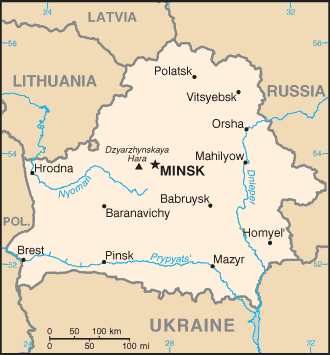
The singers state that the Belorussians are the only normal, peaceful people. They make this claim because the neighboring country drink's vodka to their health. Russia and Belarus continue to maintain an amiable relationship in the post-Soviet sphere. As a memorial to their infatuation of all things Soviet, Belarus has even kept its name for their secret service: the KGB. Belarus continues to rely on Russia for virtually all of its natural resources, enduring the politically compatible relations between Putin and Lukashenko.
The piece continues in Russia's desire to lead the long list of European countries; a fact demonstrated by it's frustration of having been denied the number one spot. Russia's Napoleon complex made itself evident in the innate necessity to be considered significant after the culmination of the Soviet Union. This explains the reasoning behind others allowing it to become member to the G-8, partner with NATO, and maintaining its chair on the UN Security Council. With an out-of-touch military that desperately needs to modernize and its economic difficulties, Russia will always seek ways of seeming important, if only outwardly.
The chorus of the song repeats the following line: "...and suddenly a shade of smile will touch your eyes, and the good mood will never leave you." Indeed, this verse seems to acknowledge that Russians will always be cognizant of and appreciate their energy power over Europe. This mocking will no doubt continue to surface in both Russian concert halls and inside Kremlin walls.


Friday, February 13, 2009
Russia to Build a Berlin Wall in Georgia?

Several reports have shown up on Georgian news sites concerning the possibility of Russia constructing walls around Abkhazia and South Ossetia. InterPressNews and The Georgian Times both speculated that the building of the walls would aim to prevent the local populations and stationed Russian soldiers from fleeing to Georgian territory. Three days later, Mikheil Saakashvili stated at Parliament that Russia was planning to build a wall in Abkhazia.
The reports coincide with the recent case of Junior Sgt. Aleksandr Glukhov, who fled the Russian-occupied Tskhinvali region and sought asylum in Georgia. While predominantly Russian news agencies maintain that the 21- year-old Russian conscript was subjected to psychological pressure or threats, the international case has largely fallen quiet.
Meanwhile, Russia’s Foreign Ministry has stated that it is unaware of any plans for the construction of a fence on South Ossetia’s border with Georgia. However, the ministry also said that the government of South Ossetia would have the right to erect an infrastructure on its border with adjacent states for national security reasons. Russian statements on the creation of a wall on the Abkhazian border with Georgia remain nonexistent for the time being.
The assertions on the Russian side evoke the same made by East German officials in 1961. That year, GDR Chairman Walter Ulbricht categorically stated in an international press conference that “No one has the intention of erecting a wall!” Two months later, a wall was constructed separating East Germany from West Germany for more than a quarter-century. November 9th of this year marks the 20th anniversary of the fall of the Berlin Wall. Lamentable though it may be, but it appears that its anniversary might signal the beginning of a new Wall in Georgia for years to come.
Georgia wants Abkhazia to be 'weapons-free' zone - minister

10/02/2009 15:11 TBILISI, February 10 (RIA Novosti) - Georgia is to demand that Abkhazia be declared an armaments-free zone, a Georgian minister said on Tuesday.
Russia and Abkhazia have agreed to open one military base in Gudauta, in the west of Abkhazia, and to establish a Russian Black Sea Fleet base in the coastal town of Ochamchira. No official documents have been signed, however.
"As for the deployment of Russian military bases in Abkhazia, Georgia will demand that Abkhazia be proclaimed a weapons-free zone, and that international police forces be deployed there," Temur Iakobashvili, the Georgian state minister on issues of reintegration, said.
Russia recognized Abkhazia and South Ossetia as independent states last year on August 26, two weeks after the end of a five-day military operation to "force Georgia to peace" which began when Georgian forces launched an attack on South Ossetia to try and regain control of the region.
Abkhazia and South Ossetia split from Georgia in the early 1990s, and most residents of both republics have had Russian citizenship for a number of years.
The chief of the Russian General Staff, Gen. Nikolai Makarov, said in November that the Russian military bases in Abkhazia and South Ossetia would be fully staffed with 3,700 personnel each by the end of 2009.
Thursday, January 29, 2009
Russian Military Suicides Still Remain High

Russia Today (RT) was very quick to make an article entitled "US army suicide highest in 3 decades" the first viewed after its main story. From an unnamed source at the Department of Defense, RT reported that at least 128 soldiers killed themselves in 2008 alone (13 more than in 2007). The English language news-service from Russia ended the piece by suggesting that:
"American troops are under unprecedented stress because of repeated and lengthy tours of duty due to simultaneous wars in Iraq and Afghanistan."
This is in stark contrast to figures coming out of Russia's armed forces, where a total of 341 military personnel committed suicide in 2007, the equivalent of an entire battalion of Russian soldiers. Fortunately, that high figure is a reduction from 15% the previous year. Analysts credit the number with the process of dedovshchina - literally, rule of the elders, in which young soldiers are often violently bullied into killing themselves.
With morale low, corruption among senior staff high, and violent prostitution all common themes, the hopelessness of military life in Russia is reason enough for many families to pay bribes to keep their children away from conscription. RT should not pretend that the US Army has an extensive problem when they themselves have been struggling for over a decade to improve their excuse for a modern military.
Monday, January 5, 2009
New Years Resolution: Russian Space Agency Will Compensate More

The head of the Russian Space Agency, or Roskosmos (RKA), plans to set a world record by launching 39 space launches in 2009. Anatoly Perminov said Monday that the schedule will include the transportation of commercial and civilian satellite launches and six Progress cargo vehicles, four manned space missions, and a host of other aeronautical missions. The Russian Duma has already approved overall space expenditures in Russia totaling about 425 billion rubles ($14.5 billion) for the 2006-2015 period. It would seem that Russia is becoming the world leader of space travel, as RIA Novosti states.
What is evident, however, is that the press agency failed to account for American space endeavors. The US has already allocated a proposed budget for NASA of $20.21 billion (up $2.89 billion from 2008) for 2009 alone. While Russia has been busy with its space tourism industry, collecting millions of dollars from persistent civilians, the US has been focusing outside Earth’s orbit. Under current NASA Administrator, Michael D. Griffin, the US is already watching over the New Horizons mission to Pluto (launched 2006/ETA 2015) and supporting President Bush’s 2004 Vision for Space Exploration, which aims to:
- Complete the International Space Station by 2010;
- Retire the Space Shuttle by 2010 and develop and conduct Orion’s (its future descendent) first human spaceflight mission by 2014;
- Develop Shuttle-Derived Launch Vehicles;
- Explore the Moon with crewed missions by 2020; and
- Explore Mars and other destinations with robotic crewed missions
Russia’s projected military expenditures for 2009 are $50 billion, several hundred billion shy of the US budget of $515.4 billion. In recognition of the dearth of Russian military spending in the post-Cold War, Russia is desperately trying to maintain its image of a superpower. Such obvious signs like the continuation of the Soviet tradition of arms parades in 2008 point to an acerbic and resentful country that relies of compensation to mitigate its citizens’ fears.
Cold War-like information warfare campaigns are becoming ubiquitous since Putin’s ascension to the presidency in late 1999. In the wake of the Columbia disaster, RKA has been reaping in the spoils of space devoid of a major US presence. Propaganda like that of RIA Novosti is commonplace and will only continue even after the US launching of the Orion program.
Friday, November 21, 2008
Espionage Claim Hits Georgian Oligarch

The oppositional New Rights Party has accused State Chancellery head, Kakha Bendukidze, of espionage. The charges assert that Bendukidze colloborated with Russian military officer, Vitaly Shlikov, and exhibited ties to the Russian military during the Russian-Georgian War. Despite these bold claims, New Rights Party Member Pikria Tchikhradze, says that the oligarch's status will make him virtually untouchable. Exactly what role Bendukidze might have played prior to and duruing the war will potentially make his case one of Georgia's most hightlighted since that of the death of Georgian oligarch, Badri Patarkatsishvili. Developments of the accusations should be closely followed in the Georgian press to see how the Saakashvili administration and the public react.
Subscribe to:
Comments (Atom)







 Posts
Posts

